


Harness engineering as code. Scaffold, lint, score and evolve the harness that keeps AI coding agents reliable in your repository.
Gear for your agents' harness. 🇧🇷 Leia em português
$ npx gearness init && npx gearness doctor

  Harness score  76/100  grade B   (loja-api)

  Context        █████████████░░░░░░░  63%
  Verification   ████████████████████ 100%
  Architecture   ████████████░░░░░░░░  60%
  Agent tooling  ████████████████████ 100%
  Safety         ████████████████████ 100%
  Feedback loop  ████████████████░░░░  81%

  Highest-impact fixes
  1. +30.0 pts 1 unfilled TODO(gearness) marker(s) - AGENTS.md (+2 more)
     ↳ replace with concrete facts about this codebase - this is where most of the value is
  2. +3.2 pts no architecture boundaries declared - harness.yaml
     ↳ declare at least one rule like `from: src/ui/**` / `deny: [src/db/**]` under `boundaries`
  3. +2.0 pts no agent hook or pre-commit hook runs gearness
     ↳ run `gearness install` - agents get feedback seconds after an edit instead of minutes later in CI
  4. +1.6 pts no ratchet entries yet - .harness/ratchet.yaml
     ↳ next time an agent repeats a mistake, run `gearness ratchet add`
  5. +1.6 pts no eval tasks yet - .harness/evals
     ↳ create one with `gearness eval new <id>`

  Agents  claude ✓   cursor ✓   copilot ✓   codex ✓
Agent = Model + Harness. The model is shared by everyone; the harness - the instructions, docs, checks, feedback
loops and guardrails around it - is what makes agents reliable in your codebase. Most teams build it ad hoc:
an AGENTS.md that grows forever, a CLAUDE.md that silently diverges from the Cursor rules, links that rot,
and the same agent mistake fixed by hand for the tenth time.
gearness makes the harness an artifact you can declare, verify, measure and gate in CI, like tests or infrastructure.
- Deterministic. No LLM calls, no network. Runs in CI in under a second.
- Agent-agnostic.
AGENTS.mdis the single source of truth; Claude Code, Cursor and Copilot files are generated from it. Codex reads it natively. - Non-destructive. Never overwrites hand-written files. Existing
CLAUDE.md/Copilot/Cursor instructions are imported, not lost. - Measures, not just scaffolds. A 0–100 score across six pillars, with the highest-impact fixes first.
- Proves it works.
gearness evalruns real tasks against your agent and compares harness versions on the same code. - Enforces architecture. Declared layer boundaries are checked against real imports (TS/JS, Python, Go).
- Lives in the agent loop. A Claude Code hook and an MCP server give agents feedback seconds after an edit, not minutes later in CI.
- Catches and fixes doc rot. Dead paths, links and anchors are flagged; renames are fixed automatically from git history.
- Infers your architecture. Proposes the layer boundaries your code already respects, verified, and draws the graph.
- Learns from mistakes. Violations caught in the loop become learned rules, so agents stop repeating them.
- Scales to monorepos and teams. Per-workspace harnesses, custom rules and shareable rule packages.
npx gearness init       # detects your stack and scaffolds the harness
# fill the TODO(gearness) markers with real knowledge about your codebase
npx gearness doctor     # score + top fixes
npx gearness lint       # problems, eslint-style (exit 1 on errors)
npx gearness install    # Claude Code hook + pre-commit + MCP server, so agents get feedback while they work
npx gearness boundaries suggest --write   # lock in the architecture you already have
Requires Node.js 18+ on Linux, macOS or Windows. Detects Node, Python, Go, Java, Rust and .NET projects,
plus Makefile, justfile and Taskfile targets. Monorepo? npx gearness init --workspaces.
| File | Purpose |
|---|---|
harness.yaml |
Declarative description of the harness: commands, context docs, agents, gates |
AGENTS.md |
Entry point for agents - a short map, not a manual |
docs/ARCHITECTURE.md, docs/CONVENTIONS.md |
Deeper context, read on demand (progressive disclosure) |
docs/STATUS.md |
Handoff between sessions: read first, update last |
.harness/ratchet.yaml |
Log of agent failures turned into durable guardrails |
.github/workflows/gearness.yml |
CI gate: lint + minimum score |
CLAUDE.md, .cursor/rules/gearness.mdc, .github/copilot-instructions.md, … |
Generated adapters for the agents you use (Claude Code, Cursor, Copilot, Gemini CLI, Windsurf, Cline; Codex reads AGENTS.md natively) |
| Command | What it does |
|---|---|
gearness init |
Scaffold the harness. --workspaces, --stack, --agents, --no-ci, --dry-run, --force |
gearness lint |
Report problems across the repo and its workspaces. --fix, --format text|json|github|sarif |
gearness doctor |
Score by pillar and top fixes. --ci gates, --base <ref> --no-regress blocks PRs that make it worse, --markdown |
gearness sync |
Regenerate adapters from AGENTS.md. --check for CI, --force to replace hand-written files |
gearness ratchet add |
Record an agent failure and the guardrail that now prevents it |
gearness ratchet list |
Show the ratchet log and the share of mechanical guardrails |
gearness check [files] |
Fast check of changed files. --staged for pre-commit, --hook claude for Claude Code |
gearness install |
Wire hooks and the MCP server into the repo. --only, --command, --uninstall |
gearness mcp |
MCP server (stdio) so agents can query the harness while they work |
gearness eval |
Run eval tasks against an agent. --runs, --parallel, --baseline <ref>, --agent, --min-pass-rate |
gearness eval new <id> / list / report |
Scaffold, list tasks, or show the pass-rate trend |
gearness boundaries suggest |
Infer layer boundaries from imports, verified against the code. --write |
gearness graph |
Module dependency graph: Mermaid, DOT or JSON, violations and cycles highlighted |
gearness context [path] |
Context X-ray: what each agent loads for a path, token cost, duplicates |
gearness learn |
Turn mistakes agents repeat into learned rules. --apply, --min |
gearness explain <rule> |
What a rule checks and its findings in this repo |
gearness badge |
Print a README badge with the current score |
gearness rules |
List all rules (built-in and custom), pillars and weights |
Exit codes: 0 ok · 1 findings or gate failed · 2 usage or config error.
Harness engineering's core habit: when an agent makes a mistake twice, don't fix the output - change the system so the mistake becomes hard to repeat, and never let that fix silently disappear.
# Best: a mechanical guardrail (lint rule, test, type, hook, CI check). It must already exist.
gearness ratchet add --fix lint --artifact eslint.config.js \
  --failure "Agent imported the database layer from a controller"

# When it can't be automated yet: a learned rule, written into AGENTS.md and synced to every agent.
gearness ratchet add --fix doc \
  --failure "Agent edited generated code" --rule "Never edit src/generated; run npm run codegen"
lint then fails if a recorded artifact is deleted or a learned rule is removed from AGENTS.md.
ratchet list shows how many of your lessons are mechanical - the number to push up over time.
$ gearness install
  + claude  .claude/settings.json added
  + git     .git/hooks/pre-commit added
  + mcp     .mcp.json added
Now, seconds after Claude Code edits a file that crosses a boundary or leaks a key, it reads:
gearness: this change breaks the repository's harness rules.
- src/ui/page.tsx:1 imports ../db/pool (crosses src/ui/** ✗ src/db/**) - UI talks to services only [architecture/boundaries]
  fix: go through the allowed layer instead of importing across the boundary
…and fixes it before moving on. Through the MCP server, agents can also ask harness_can_import before writing an
import and harness_check_files before declaring a task done. See docs/integrations.md.
$ gearness boundaries suggest --write

  Architecture inferred from imports (6 modules under src, 9 cross-module imports)
  3 boundaries that the code already respects (verified: 0 violations today)
  ✓ added 3 boundaries to harness.yaml
No one has to write layering rules by hand: gearness reads the import graph, proposes "lower layers never import the
layers above them" for every one-directional dependency, verifies each proposal has zero violations today, and reports
cycles instead of hiding them. --strict freezes the whole graph, so an agent cannot add a new coupling (or skip a
layer) without a deliberate change to harness.yaml. Tests are exempt automatically. gearness graph --markdown
renders it as a Mermaid diagram with violations in red.
See docs/architecture.md.
$ gearness context packages/api/src/index.ts

  claude    ~894 tokens always loaded
    ● CLAUDE.md                                   52  repository root
    ● AGENTS.md                                  425  imported by CLAUDE.md
    ● packages/api/CLAUDE.md                      52  nested in packages/api/
    ● packages/api/AGENTS.md                     365  imported by packages/api/CLAUDE.md
    ○ docs/ARCHITECTURE.md                       172  linked from the entry file
  copilot   ~878 tokens always loaded
    ● .github/copilot-instructions.md            457  repository-wide
    ● .github/instructions/packages-api.…        421  applyTo packages/api/**
  windsurf  ~468 tokens always loaded
    ● .windsurf/rules/gearness.md                468  trigger: always_on
What each agent actually loads for a given path, following each tool's documented rules: nested files, @imports,
glob-scoped rules, applyTo. It shows the token cost, duplicated instructions, and gaps (above: Windsurf gets no
workspace-specific rules).
Every violation the hooks and MCP catch is logged locally. gearness learn finds what agents keep getting wrong and
--apply turns it into learned rules in AGENTS.md, so the next session gets it right the first time.
See docs/learning.md.
$ gearness eval --baseline main --runs 3

  task                         current   main          Δ
  add-health-endpoint          3/3       1/3           +67%
  fix-pagination-bug           2/3       2/3           0%

  Pass rate  current 83%   main 50%   Δ +33 pp
Each run happens in a throwaway git worktree with the same code and a different harness, so the delta comes from your harness change. Tasks are YAML files with a prompt, a check command and files the agent must not touch. Works with Claude Code, Codex, Aider, Gemini CLI or any command. See docs/eval.md.
boundaries:
  - from: "src/ui/**"
    deny: ["src/db/**", "axios"]
    message: UI goes through services
src/ui/page.tsx
:1 error imports ../db/client (crosses src/ui/** ✗ src/db/**) - UI goes through services
Drop a file in .harness/rules/ or share rules as an npm package - see docs/plugins.md.
Twenty-one rules across six pillars - context, verification, architecture, agent tooling, safety and feedback loop - each worth points. A freshly scaffolded harness scores around 75: the structure is there, the knowledge isn't yet. See docs/rules.md for every rule and docs/principles.md for the reasoning.
init adds .github/workflows/gearness.yml. Or use the action directly:
- uses: actions/checkout@v7
- uses: TomazAlexandre/gearness@v0
  with:
    min-score: 80   # optional, overrides gates.minScore
On pull requests the generated workflow also compares with the base branch and fails if the harness got worse
(doctor --base origin/main --no-regress). The action annotates problems inline on the PR diff, can keep one up-to-date report comment on the PR (comment: true), writes a markdown report to the job summary, can emit SARIF for
code scanning (sarif: true), and exposes the score as steps.<id>.outputs.score.
Add the score to your README with gearness badge.
See docs/configuration.md; a JSON Schema gives you autocompletion in VS Code and JetBrains. Minimal example:
version: 1
project:
  name: loja-api
stack: node
commands:
  test: npm run test
  lint: npm run lint
context:
  entry: AGENTS.md
  docs: [docs/ARCHITECTURE.md, docs/CONVENTIONS.md]
  status: docs/STATUS.md
agents: [claude, cursor, copilot, codex]
gates:
minScore: 70-
init,lint,doctor,sync,ratchet, GitHub Action -
gearness evalwith baselines, forbidden files and pass-rate gates - Custom rules and plugin packages
- Architecture boundaries (TS/JS, Python, Go)
- Monorepos, Gemini CLI / Windsurf / Cline, Rust / .NET, just / Taskfile, Windows
- Claude Code hook, pre-commit, MCP server; GitHub annotations and SARIF; stale-doc detection
- TypeScript path aliases, Java / Kotlin / C# boundaries; parallel evals and trends; JSON Schema
- Architecture inference and graph, context X-ray, learning loop, regression gate, rename-aware doc fixes
- Official rule presets (Next.js, Django, Spring, Go services)
- Hooks for Cursor, Gemini CLI and Codex as their hook APIs stabilize
- Optional LLM-assisted plugins (suggest a guardrail for a ratchet entry, draft ARCHITECTURE.md)
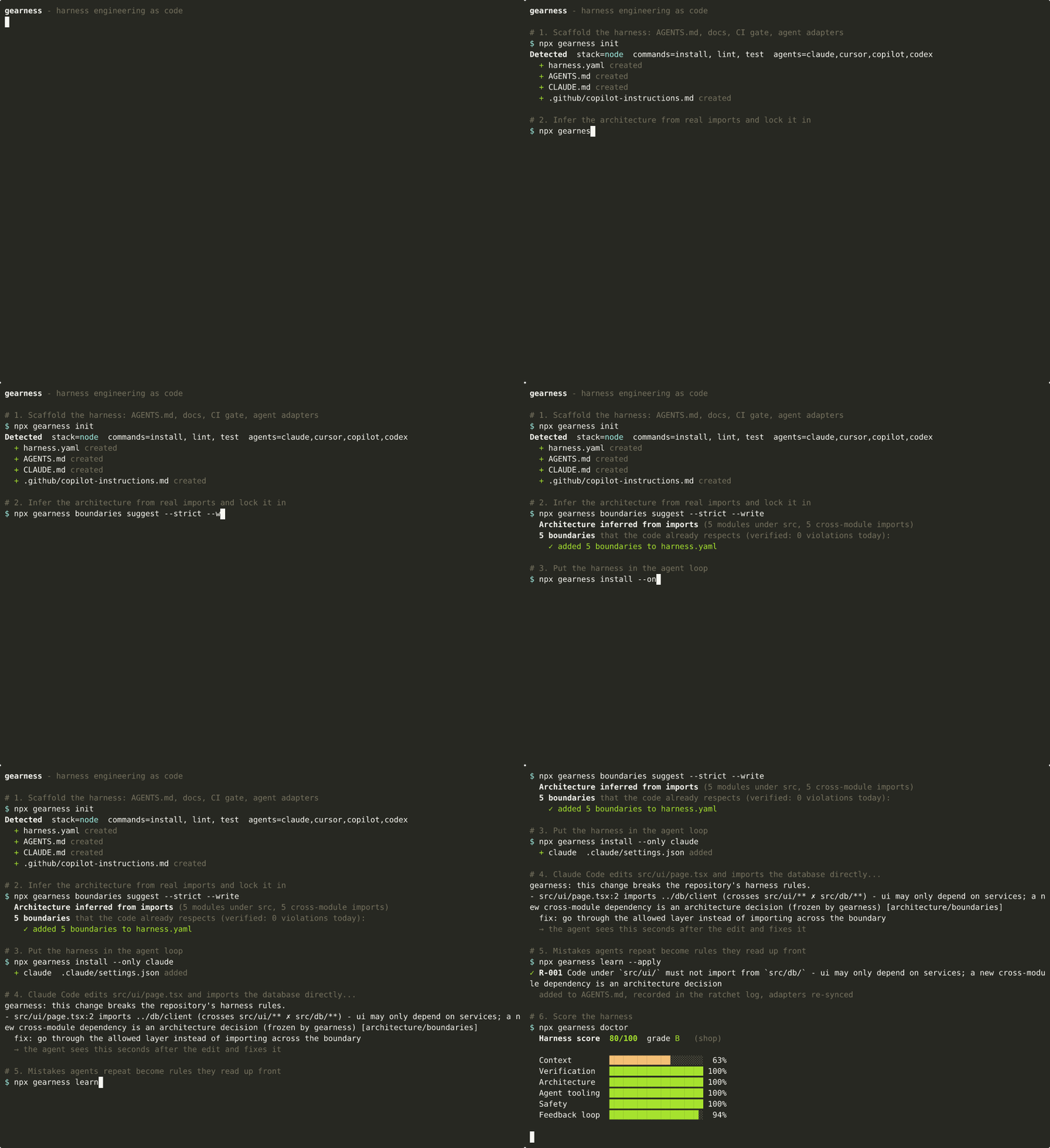
The GIF at the top is this script, recorded as is:
npm run demoThe demo creates a small layered app, infers and freezes its architecture, installs the Claude Code hook, simulates an agent importing the database from the UI (caught instantly, twice), learns a rule from it, and prints the graph, the context X-ray and the score.
Issues and PRs welcome - see CONTRIBUTING.md. This repository is harnessed with gearness itself: start with AGENTS.md.
MIT © Tomaz Alexandre