
A dependency-free PHP administration SDK. Install it, mount it on a URL, describe your pages in configuration files, and get a working admin.
Status: 0.1.0, installable. Grids, forms, actions, previews, bulk writes, administrators, roles, workspaces, an audit log, mail and uploads all work, on MySQL and PostgreSQL, behind 2900 tests. What 0.x means here: the configuration format, the page schema and the public classes are documented and in use, and may still change between 0.x releases where using them teaches us something. The design specification is the agreed architecture and records why each decision was made.
Most admin packages are tied to one framework and one of its major versions. When the framework moves, the admin has to move with it, and an admin panel is exactly the kind of software that should be left alone for years.
RockAdmin takes the opposite approach. Its composer.json requires PHP and
three core extensions — nothing else:
"require": {
    "php": "^8.4",
    "ext-pdo": "*",
    "ext-json": "*",
    "ext-mbstring": "*"
}
No Laravel, no Symfony, no ORM, no template engine, no npm, no build step. There is nothing to conflict with whatever your project already uses, and nothing that forces an upgrade when someone else ships a major version.
Your project hands RockAdmin a request path; RockAdmin hands back a response. In Laravel that is one line:
Route::any('/admin/{path?}', fn ($path = '') => RockAdmin::handle(
    $path,
    basePath: base_path(),
    pdo: fn () => DB::connection()->getPdo(),
)->body)->where('path', '.*');
Without a framework, it is RockAdmin::serve() from an index.php, which
reads the path itself. Pretty URLs are optional — ?ra=p/users works just as
well, so no mod_rewrite is required.
The installation is four commands, and the installation guide is the long version:
composer require tomac1/rockadmin
vendor/bin/rockadmin init          # writes config/rockadmin/*, commit it
vendor/bin/rockadmin migrate       # creates the ra_ tables
vendor/bin/rockadmin user:create   # the first administrator
vendor/bin/rockadmin doctor        # checks everything else
Everything an admin page does is described in one file kept in git:
<?php return [
    'title'  => 'Ads',
    'layout' => 'list',

    'entity' => ['table' => 'ads', 'key' => 'id'],

    'regions' => [
        'grid' => [
            'type'     => 'list',
            'per_page' => 50,
            'sort'     => ['created_at' => 'desc'],
            'columns'  => [
                'id'         => ['type' => 'int', 'width' => '60px'],
                'title'      => ['type' => 'text', 'sortable' => true, 'link' => 'edit',
                                 'filter' => ['type' => 'text', 'op' => 'contains']],
                'user_name'  => ['type' => 'text', 'label' => 'Author',
                                 'source' => ['join' => 'users ON users.id = ads.user_id',
                                              'column' => 'users.name']],
                'price'      => ['type' => 'money', 'currency' => 'CZK', 'align' => 'right'],
                'created_at' => ['type' => 'datetime', 'format' => 'd.m.Y H:i'],
            ],
            'row_actions'  => ['edit', 'preview', 'copy', 'delete'],
            'bulk_actions' => ['delete', 'publish'],
        ],
    ],

    'form'    => ['fields' => [/* ... */]],
    'preview' => ['mode' => 'offcanvas', 'fields' => [/* ... */]],
];
Or let the scaffolder read your database and write the first draft:
vendor/bin/rockadmin make:page ads --table=adsEvery picture here is the demo in this repository, running on the default
theme with nothing added: php -S localhost:8080 -t demo demo/index.php.
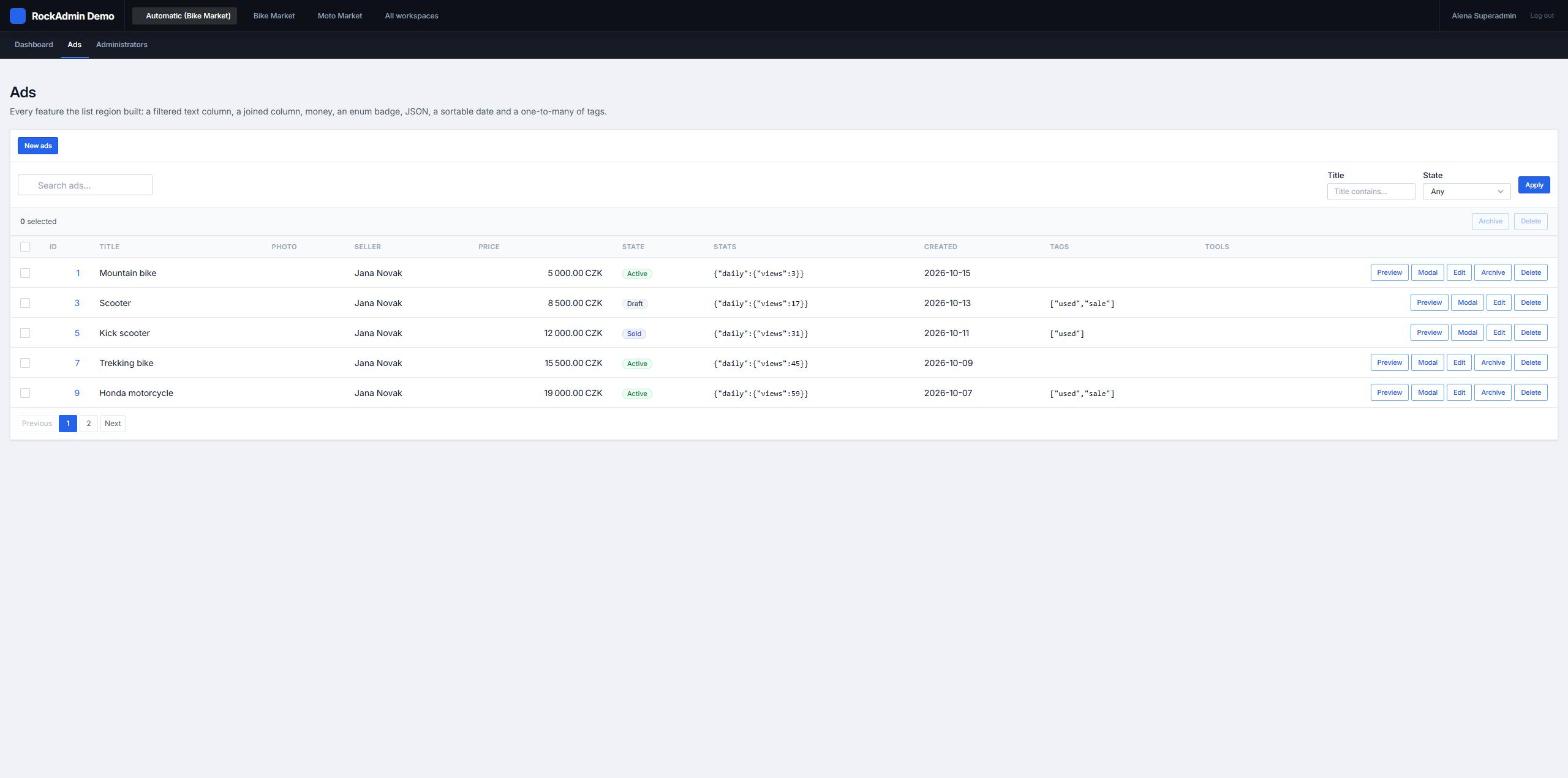
A grid. One page file produced all of it — the search box, the filters, the money column, the enum badge, the JSON column, the joined seller, the one-to-many tags, the row controls, the bulk bar and the workspace switcher in the navbar.
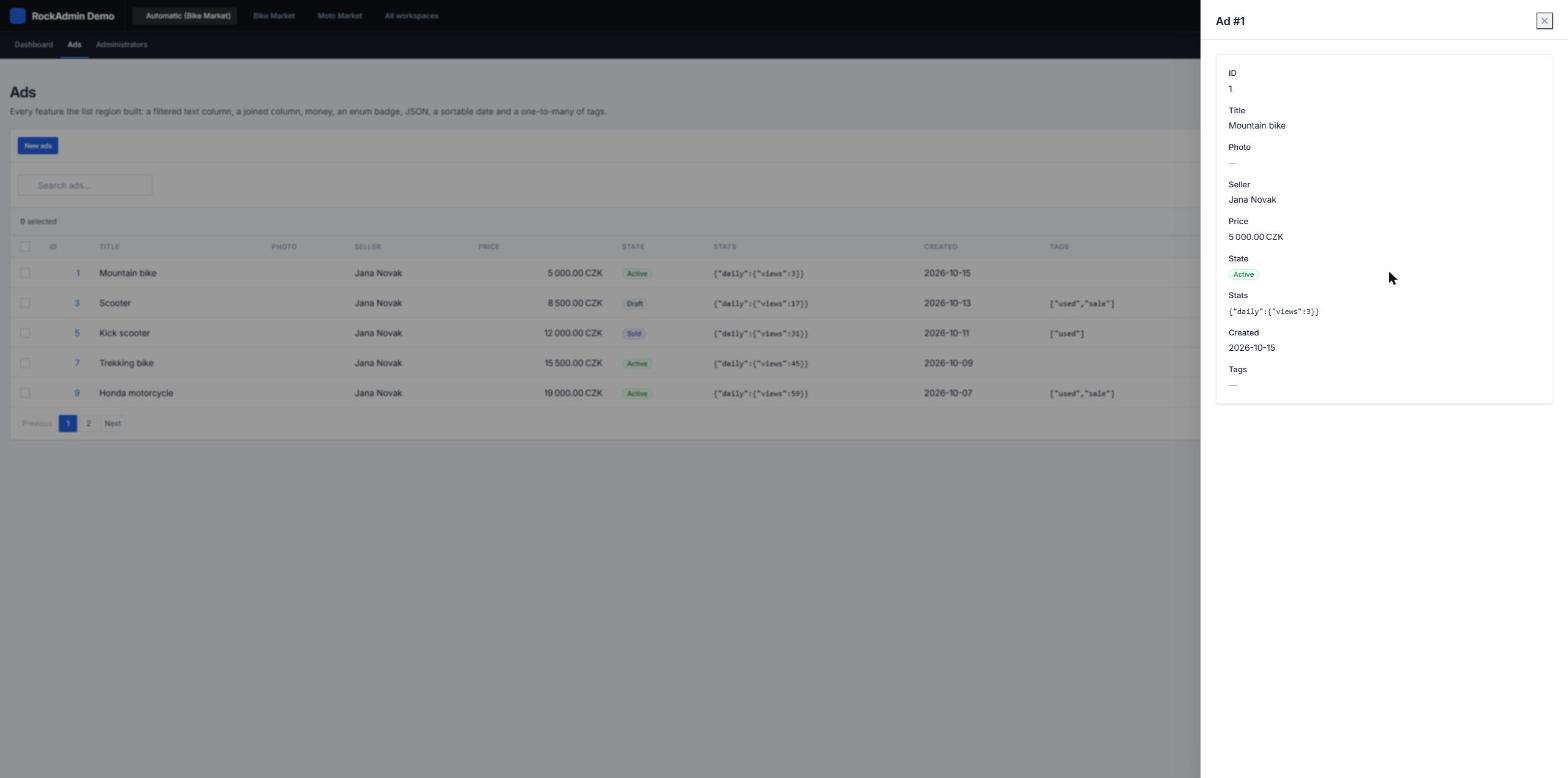
A preview, without leaving the page. The same region the detail URL renders, drawn in an offcanvas panel, which is one key in the page file.
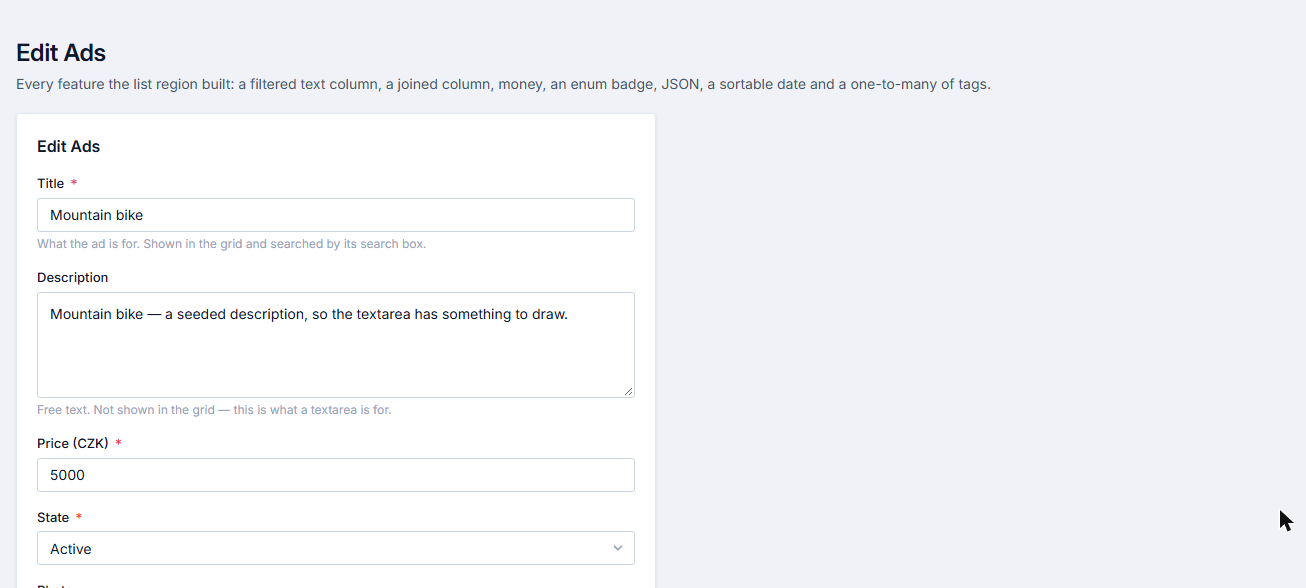
A form. Create, edit and copy are one region drawn three ways, and the labels, help text, validation and defaults all come from the same file.
The front page, which lists what the person signed in may actually open — nothing they cannot.

Everything is a region. A page is a layout with named slots, and each slot holds a region with its own definition, its own templates and its own URL. A list view is a page with one region. A message inbox is a page with a list and a preview region that depends on it. Adding a new kind of page means writing a layout file, not new code.
Queries are explicit and inspectable. Grids compose a single SELECT with deduplicated JOINs. A one-to-many relation issues one extra query for the whole page of rows, never one per row — there is no code path through which a query can be made inside a row loop. The development console shows every query with its timing, ready to copy and run against your database.
Configuration is validated against a schema. Every option has a schema entry carrying its type, default, description and example. The reference documentation is generated from it, and CI rejects any key the code reads but the schema does not declare — so an undocumented feature cannot ship.
Every element is addressable. Alongside Bootstrap classes, each element carries a structural class and an identity class:
<td class="ra-grid-cell ra-grid-cell-price">Restyle every grid in the application with one selector, or one cell on one page, without touching a template. When CSS is not enough, copy the template into your project — the cascade picks yours over the SDK's, file by file.
Behaviour survives AJAX. Listeners are delegated and per-element behaviour is declared with attributes, so HTML inserted after page load works exactly like HTML that arrived with it.
- PHP 8.4 or newer, with
pdo,jsonandmbstring - MySQL / MariaDB or PostgreSQL
- A way to route admin requests to one entry point — a rewrite rule, your
framework's router, or
?ra=
RockAdmin keeps its administrators in its own ra_-prefixed tables rather
than in your users table: five admins and a hundred thousand customers need
different fields and different security properties, and your own schema stays
yours to restructure. The DDL ships with the package, in migrations/, so the
schema does not fork per project.
Run it once per deploy:
vendor/bin/rockadmin migrate # --dry-run prints the SQL insteador, where the application would rather call the class from its own deploy hook:
(new RockAdmin\Db\Migrator(RockAdmin\Db\Connection::fromPdo($pdo)))->migrate();Either is safe to run every time: a migration already recorded in
ra_migrations is not applied again. One caveat is worth knowing before you
need it — PostgreSQL rolls a failed migration back completely, but MySQL
commits every CREATE TABLE implicitly, so a migration that fails halfway
there leaves what it had already created behind and has to be tidied by hand
before it is retried.
A themed admin shell — navbar, menu, a page header with buttons, a flash message — is running in this repository right now:
php -S localhost:8080 -t demo demo/index.phpOpen http://localhost:8080/. See demo/README.md for
what it is and is not: it is the design surface the default theme is tuned
against, kept honest to the general case.
/p/ads is a real grid over fixture tables — a filtered text column, a
joined column, money, an enum badge, JSON, a sortable date and a one-to-many
of tags, sorted and paginated with JavaScript on or off. It needs a
database; demo/seed.php fills one from the same variables the test suite
reads. See demo/README.md for the exact steps.
The same page also creates, edits, copies and deletes a row — a text field, a
textarea, a number, a select from a shared enumeration, a checkbox, a date and
a hidden field stamped with @now, all declared in the same file as the grid.
Every write is a plain POST with a CSRF token and runs inside a transaction,
so it works with JavaScript switched off, and an invalid submission comes back
with every error at once and what was typed still in the inputs.
All of it is behind a sign-in. demo/seed.php seeds three administrators — a
superadmin, an editor and a viewer, with Argon2id hashes — so the difference a
role makes is something you can look at rather than read about: the viewer's
grid has no actions column at all, the editor sees Edit and never Delete, and a
forbidden URL typed by hand is a 403 whether it addresses a page, a fragment or
a write. Every write leaves one row in ra_activity_log naming the person who
made it and carrying its diff.
- Design specification — the complete architecture and the reasoning behind each decision
- Configuration reference and setup guides — published once implementation begins
Issues and pull requests are welcome. Please read CONTRIBUTING.md first; it explains the constraints this project is built around, the most important being that RockAdmin does not take on dependencies.
Security vulnerabilities go through private reporting, never a public issue.
MIT — see LICENSE.md.