
An interactive evolutionary transit map tracking how the public research repositories and publications in KathiraveluLab connect and evolve across distributed systems, network optimization, biomedical imaging, autonomous trust, and community science.

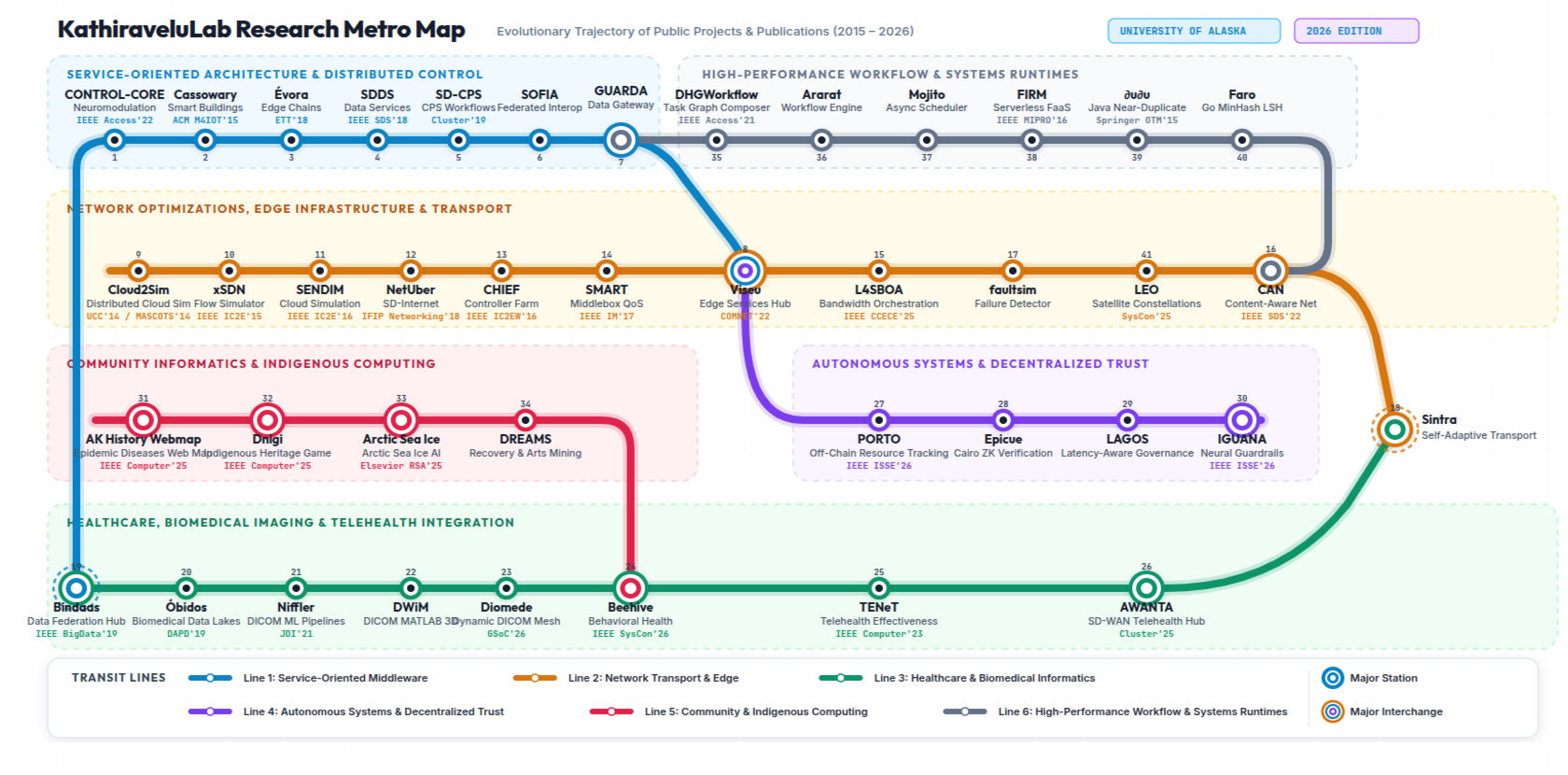
The metropolitan map organizes 41 flagship research stations across 6 interconnected transit lines, reflecting over a decade of research:
| Line | Name | Color | Core Research Focus |
|---|---|---|---|
| Line 1 | Service-Oriented & Distributed Middleware | Cyan (#0284c7) |
Closed-loop neuromodulation, context-aware smart buildings, service chaining, CPS, and federated interoperability. |
| Line 2 | Network Transport & Edge Infrastructure | Amber (#d97706) |
Cloud/MapReduce simulation, dynamic flow modeling, community network controller farms, middlebox QoS, bandwidth orchestration, fault detectors, and LEO satellite constellations with inter-satellite links. |
| Line 3 | Healthcare & Biomedical Informatics | Emerald (#059669) |
High-throughput DICOM ML pipelines, dynamic telemedicine routing mesh, behavioral health data federation, and rural telehealth. |
| Line 4 | Autonomous Systems & Decentralized Trust | Purple (#7c3aed) |
Blockchain-based edge middleware, verifiable off-chain state channels, Cairo ZK proofs, latency-bounded governance, and neural guardrails. |
| Line 5 | Community Informatics & Circumpolar Computing | Slate Gray (#64748b) |
Alaska Native epidemic history mapping, Indigenous serious games, Arctic sea ice forecasting, and art therapy mining. |
| Line 6 | High-Performance Workflow & Systems Runtimes | Crimson Red (#e11d48) |
Hypergraph workflow composition, Mojo SIMD execution, lock-free task orchestration, and Go deduplication. |
Bindaas: Foundational milestone station preceding CONTROL-CORE on Line 3 (Clinical Healthcare & Biomedical Informatics), federating heterogeneous clinical repositories and providing the foundational RESTful data architecture forÓbidos.CONTROL-CORE: Major Western transfer hub bridging Line 3 (Healthcare Informatics) and Line 1 (SOA Middleware), linking closed-loop peripheral neuromodulation with distributed service-oriented systems.Cloud2Sim: Adaptive distributed cloud simulation milestone serving as the western starting point of Line 2 (Network Transport & Edge Infrastructure).CHIEF: Major Western transfer hub bridging Line 1 (SOA Middleware) and Line 2 (Network Transport), coordinating software-defined community network controller farms.Viseu: Major triple-interchange bridging Line 1 (SOA Middleware), Line 2 (Network Optimization), and Line 4 (Autonomous Decentralized Trust), connecting edge orchestration directly with Ethereum trust and private off-chain state channels toPORTO.GUARDA: Dual-interchange transfer hub bridging Line 1 (SOA Middleware) and Line 6 (Workflow & Systems Runtimes).CAN: Dual-interchange transfer hub bridging Line 2 (Network Transport) and Line 6 (Workflow & Systems Runtimes).Beehive: Interdisciplinary junction connecting Line 3 (Clinical Healthcare) with Line 5 (Community Informatics).Sintra: Major triple-interchange bridging Line 2 (Network Transport), Line 3 (Clinical Healthcare), and Line 4 (Autonomous Systems & Decentralized Trust) across satellite, edge, and zero-knowledge trust channels.
- CONTROL-CORE (
controlcore-project): Closed-loop peripheral neuromodulation (IEEE Access'22, Springer Cluster'25), orchestrating feedback loops via the NEXUS software-defined workflow framework. - CHIEF (
CHIEF,messaging4transport): Controller farm for clouds of software-defined community networks (IEEE IC2EW'16). - Cassowary (
Cassowary): Context-aware smart buildings and decentralized SD-MANETs for IoT & smart homes (ACM M4IOT'15, IJCAC'26). - Évora (
Evora): Adaptive edge service chaining (Trans. Emerging Tel. Tech. (ETT)'18, IEEE ICWS'16). - SDDS (
SDDS,messaging4transport): Software-defined data services (IEEE SDS'18). - SD-CPS (
SD-CPS): Software-defined cyber-physical systems (Springer Cluster'19, IEEE SDS'17). - SOFIA (
SOFIA): Service-oriented federated interoperability in Erlang. - GUARDA (
GUARDA): Uniform remote data and analytics gateway in Elixir. - Viseu (
Viseu): Virtual Internet services at the edge and decentralized blockchain framework (Computer Networks (COMNET)'22).
- Cloud2Sim (
Cloud2Sim): Adaptive distributed simulator for Cloud and MapReduce algorithms (IEEE/ACM UCC'14, IEEE MASCOTS'14). - CHIEF (
CHIEF,messaging4transport): Controller farm for clouds of software-defined community networks (IEEE IC2EW'16). - xSDN (
xSDN): Expressive simulator for dynamic network flows (IEEE IC2E'15). - SENDIM (
SENDIM): Cloud network simulation, emulation, and deployment (IEEE IC2E'16, Springer OTM'16). - NetUber (
NetUber): Software-defined Internet routing and dynamic IXP peering via Dynam-IX (ACM SIGCOMM / CoNEXT'18, IFIP Networking'18, IEEE SDS'20). - SMART (
SMART,messaging4transport): SDN middlebox architecture for resilient transfers (IEEE IM'17, Springer OTM'16). - L4SBOA (
L4SBOA): L4S bandwidth orchestration for ultra-low latency (IEEE CCECE'25). - faultsim (
faultsim): Distributed cluster failure detector under extreme network instability in Rust. - LEO (
LEO): Low Earth Orbit satellite network simulation with inter-satellite links (IEEE SysCon'25). - CAN (
CAN): Content-aware networking in Rust and telesurgery innovations review (IEEE SDS'22).
- Bindaas (
bindaas,TCIA-API,TCIA-REST-API-Client): Foundational RESTful data access federation middleware, PRISM, and open access image repositories (IEEE BigData'19, JCO CCI'20, MoNeTec'22). - CONTROL-CORE (
controlcore-project): Closed-loop peripheral neuromodulation (IEEE Access'22, Springer Cluster'25), linking clinical neuromodulation with distributed middleware. - Óbidos (
Obidos,MEDIator,datacafe): Big data integration and federation, dynamic data warehousing, and biomedical data lakes (Springer DAPD'19, VLDB DMAH'17, VLDB DMAH'16, AMIA'16, ACM BigCHat (KDD)'15). - Niffler (
Niffler,MRIQC): High-throughput DICOM machine learning pipelines and edge MRI image quality assessment (Springer JDI'21, IEEE Access'21, IEEE Computer'22, IEEE CCECE'24). - DWiM (
DWiM): Automated DICOM 3D volume assembly, slice sorting, and isotropic resampling in MATLAB. - Diomede (
Diomede): Dynamic DICOM endpoint routing mesh and telemedicine toolkit across regional cloud PACS nodes. - Beehive (
Beehive): Behavioral health data framework with digitized drawings and photographs (IEEE SysCon'26). - TENeT (
TENeT): Telehealth necessity, clinical outcome tracking, and telehealth dilemma analysis (IEEE Computer'23, IEEE CCECE'24). - AWANTA (
AWANTA): SD-WAN for remote telehealth measurements (Springer Cluster'25, IEEE SDS'23).
- PORTO (
PORTO): Private off-chain resource tracking and orchestration, and enterprise blockchain in healthcare (IEEE ISSE'26, IEEE SDS'25). - IGUANA (
IGUANA): Integrated guardrails for unbiased, adaptive neural network architectures (IEEE ISSE'26). - Epicue (
Epicue): Zero-knowledge computational integrity with Cairo STARKs in untrusted cloud environments. - Sintra (
Sintra,sintra-plot): Self-adaptive interdomain network latency measurements and monitoring with RIPE Atlas. - LAGOS (
LAGOS): Latency-aware accountable overlay governance in Gleam.
- AK Native Webmap (
ak-history-webmap): Interactive Alaska Native history web map for epidemic disease outbreaks (IEEE Computer'25). - Dnigi (
Dnigi): Serious game for Indigenous cultural heritage transmission (IEEE Computer'25). - Arctic Sea Ice (
DIP_Predicting_SIE): Circumpolar satellite image processing and sea ice extent prediction (Elsevier Remote Sensing Applications'25). - DREAMS (
DREAMS): Digitization for recovery and arts mining for societal well-being.
- ∂u∂u (
dudu): Foundational multi-tenanted framework for distributed near-duplicate detection in big data written in Java (Springer OTM'15), serving as the starting terminal station of Line 6. - GUARDA (
GUARDA): Uniform remote data and analytics gateway in Elixir, serving as the major transfer hub with Line 1 (SOA Middleware). - DHGWorkflow (
DHGWorkflow): Directed hypergraph workflow composer originating from the NEXUS software-defined workflow orchestration framework for cyclic closed-loop pipelines (IEEE Access'21). - Ararat (
Ararat): Hardware-accelerated hypergraph executor in Mojo. - FIRM (
FIRM): Find, Invoke, Return, and Manage low-overhead service composition (IEEE MIPRO'16). - Faro (
Faro): High-throughput near-duplicate detection in Go using MinHash and Locality-Sensitive Hashing (LSH). - CAN (
CAN): Content-aware networking in Rust and telesurgery innovations review (IEEE SDS'22), serving as the major transfer hub with Line 2 (Network Transport). - Mojito (
Mojito): Asynchronous task orchestrator in Mojo, serving as the terminal station of Line 6 following the CAN interchange.
This web application is fully static and configured for immediate deployment to GitHub Pages at: https://kathiravelulab.github.io/Metro/
- In the GitHub repository, navigate to Settings -> Pages:
https://github.com/KathiraveluLab/Metro/settings/pages - Under Build and deployment -> Source:
- Select GitHub Actions (the automated workflow in
.github/workflows/deploy.ymlwill handle verification and deployment on every push), or - Select Deploy from a branch -> Branch:
main-> Folder:/ (root).
- Select GitHub Actions (the automated workflow in
- The live interactive application will be published at:
https://kathiravelulab.github.io/Metro/
You can embed this map into personal academic pages (such as pradeeban.github.io or kathiravelulab.github.io) using any of the following methods:
Embed the complete interactive web application (with pan, zoom, station inspector drawer, search, and theme toggle) directly into your website.
<div style="position: relative; width: 100%; height: 720px; max-width: 1400px; margin: 2rem auto; border: 1px solid #cbd5e1; border-radius: 12px; overflow: hidden; box-shadow: 0 4px 20px rgba(0,0,0,0.06); background: #ffffff;">
  <iframe
    src="https://kathiravelulab.github.io/Metro/"
    width="100%"
    height="100%"
    style="border: none; display: block;"
    title="KathiraveluLab Research Metro Map"
    loading="lazy"
    allow="fullscreen">
  </iframe>
</div>Raw HTML is fully supported in kramdown/Jekyll:
<iframe
  src="https://kathiravelulab.github.io/Metro/"
  width="100%"
  height="680"
  style="border: 1px solid #cbd5e1; border-radius: 10px; box-shadow: 0 4px 16px rgba(0,0,0,0.06); background: #ffffff;"
  title="KathiraveluLab Research Metro Map"
  loading="lazy">
</iframe>Create _includes/metro-map.html in your personal Jekyll repository:
<div class="metro-map-container" style="width: 100%; height: {{ include.height | default: '700px' }}; margin: 1.5rem 0; border: 1px solid #cbd5e1; border-radius: 12px; overflow: hidden; box-shadow: 0 4px 16px rgba(0,0,0,0.08); background: #ffffff;">
  <iframe
    src="https://kathiravelulab.github.io/Metro/{% if include.station %}#station={{ include.station }}{% elsif include.line %}#line={{ include.line }}{% endif %}"
    width="100%"
    height="100%"
    style="border: none;"
    title="KathiraveluLab Research Metro Map"
    loading="lazy">
  </iframe>
</div>
Then call it from any page on pradeeban.github.io:
{% include metro-map.html height="720px" %}Or pre-focus on a specific project:
{% include metro-map.html station="niffler" %}The vector SVG diagram (assets/kathiravelulab-metro-map.svg) and high-resolution screenshot (assets/kathiravelulab-metro-map.png) are generated on a solid white background with crisp typography and subtle region tints, making them suitable for academic pages, slides, and papers.
[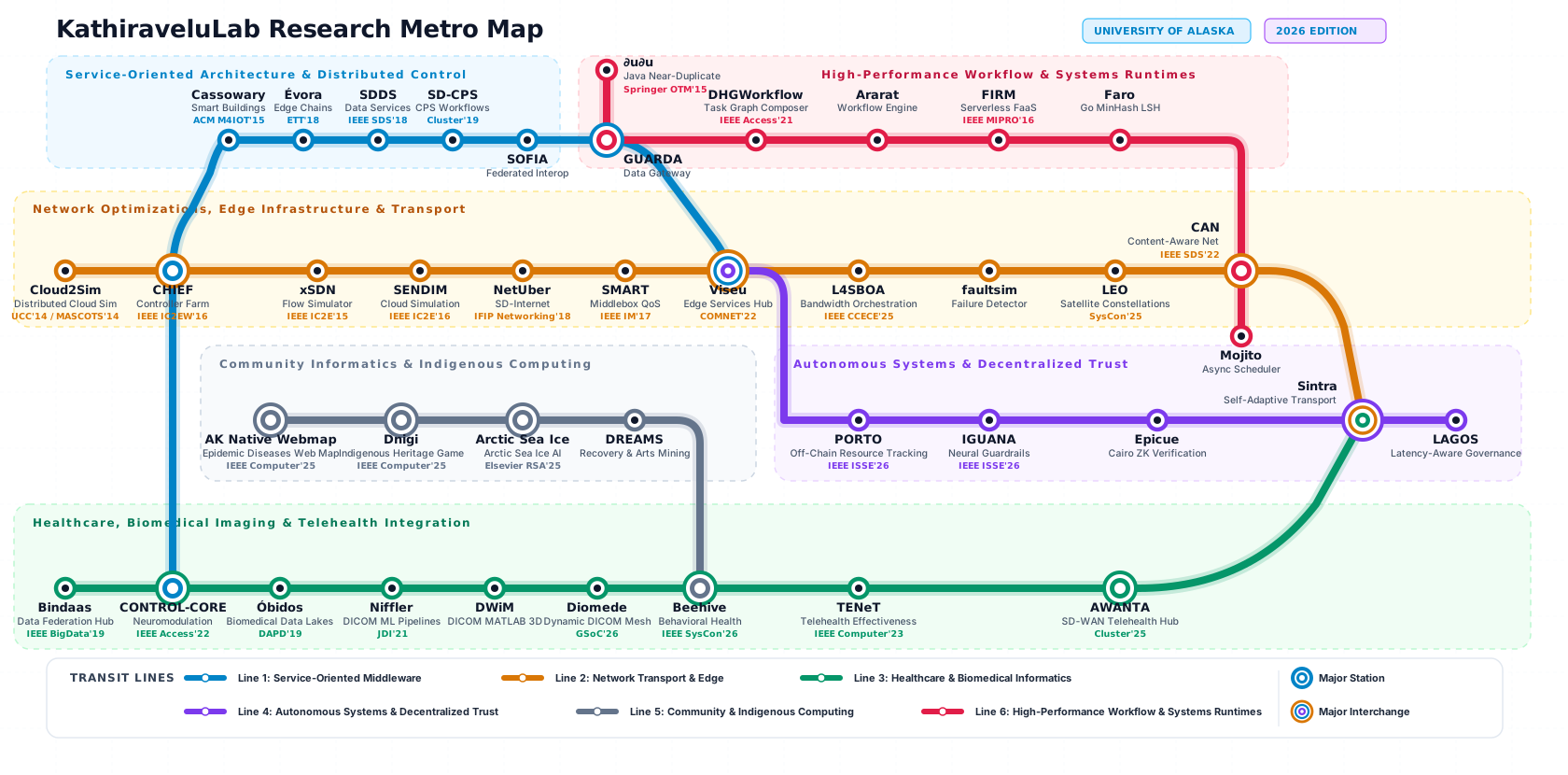](https://kathiravelulab.github.io/Metro/)<a href="https://kathiravelulab.github.io/Metro/" target="_blank" rel="noopener noreferrer">
<img
src="https://kathiravelulab.github.io/Metro/assets/kathiravelulab-metro-map.svg"
alt="KathiraveluLab Research Metro Map"
width="100%"
style="max-width: 1200px; height: auto; border: 1px solid #e2e8f0; border-radius: 8px; background: #ffffff;" />
</a>If a raster image is preferred (for example, for PDF generation or older browsers):
[](https://kathiravelulab.github.io/Metro/)External project pages or publication lists on pradeeban.github.io can deep-link directly to any station or line. The application automatically pans to and spotlights the requested node on load:
- Link to CONTROL-CORE (Neuromodulation):
https://kathiravelulab.github.io/Metro/#station=control-core - Link to Niffler (DICOM ML Pipelines):
https://kathiravelulab.github.io/Metro/#station=niffler - Link to AWANTA (SD-WAN Telehealth):
https://kathiravelulab.github.io/Metro/#station=awanta - Link to Sintra (Transport Optimization):
https://kathiravelulab.github.io/Metro/#station=sintra - Link to Dnigi (Indigenous Heritage Game):
https://kathiravelulab.github.io/Metro/#station=dnigi - Spotlight Line 1 (SOA & Middleware):
https://kathiravelulab.github.io/Metro/#line=line-soa - Spotlight Line 2 (Network Transport):
https://kathiravelulab.github.io/Metro/#line=line-net - Spotlight Line 3 (Healthcare Informatics):
https://kathiravelulab.github.io/Metro/#line=line-health - Spotlight Line 4 (Autonomous Trust & AI):
https://kathiravelulab.github.io/Metro/#line=line-trust - Spotlight Line 5 (Community & Indigenous):
https://kathiravelulab.github.io/Metro/#line=line-community - Spotlight Line 6 (Workflow & Systems Runtimes):
https://kathiravelulab.github.io/Metro/#line=line-shuttle
You can launch and explore the interactive web app locally using Python or Node.js:
# Using Python
python3 -m http.server 3838

# Or using Node.js
npx -y serve -p 3838 .
Then open your browser at http://localhost:3838/.
- Interactive 2D Panning & Zooming: Smooth drag-and-pan canvas with mouse wheel and keyboard arrow support.
- Station Inspector Slide-Over: Click any station to inspect publications, abstract, tech stack tags, and direct GitHub links.
- Line Spotlighting: Filter by any line in the header navigation to highlight specific research thrusts.
- Real-Time Search: Search by repository, programming language (for example,
Erlang,Cairo,Mojo,Rust), venue (IEEE Computer,Cluster), or topic (Alaska,Telehealth). - Dark & Light Mode: Toggle between high-contrast dark aesthetic and clean academic publication light mode.
- One-Click Standalone SVG Export: Download the SVG vector map directly for embedding into papers or presentations.
To regenerate the standalone vector asset assets/kathiravelulab-metro-map.svg after editing metro-data.js:
node generate-svg.js- Principal Investigator: Pradeeban Kathiravelu, Ph.D.
- Organization: KathiraveluLab, University of Alaska Anchorage & Global Collaborators
- Initiatives: Google Summer of Code (GSoC) Alaska, Alaskan Season of Code